
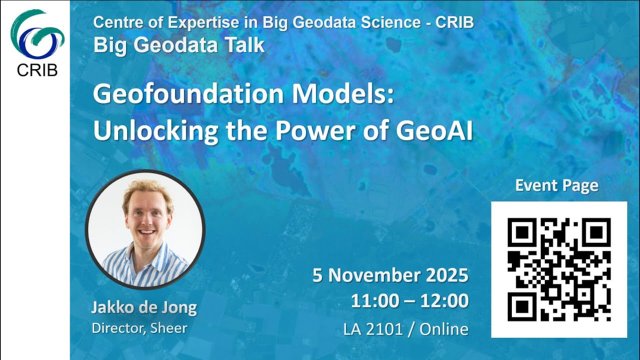
Geofoundation Models: Unlocking the Power of GeoAI

Join us for the Big Geodata Talk on Geofoundation Models by Spheer!

Geospatial foundation models (geo-FMs) are rapidly transforming the way we analyze and understand our planet. By leveraging vast amounts of satellite and geospatial data, these models provide a powerful foundation for tackling complex spatial challenges with unprecedented scale and efficiency. Similar to the role of large language models in natural language processing, geo-FMs serve as versatile starting points that can be fine-tuned for diverse applications, from environmental monitoring to climate adaptation. They significantly reduce the need for labeled data, improve the consistency of analysis over time, and open new opportunities for collaboration between science, government, and industry.

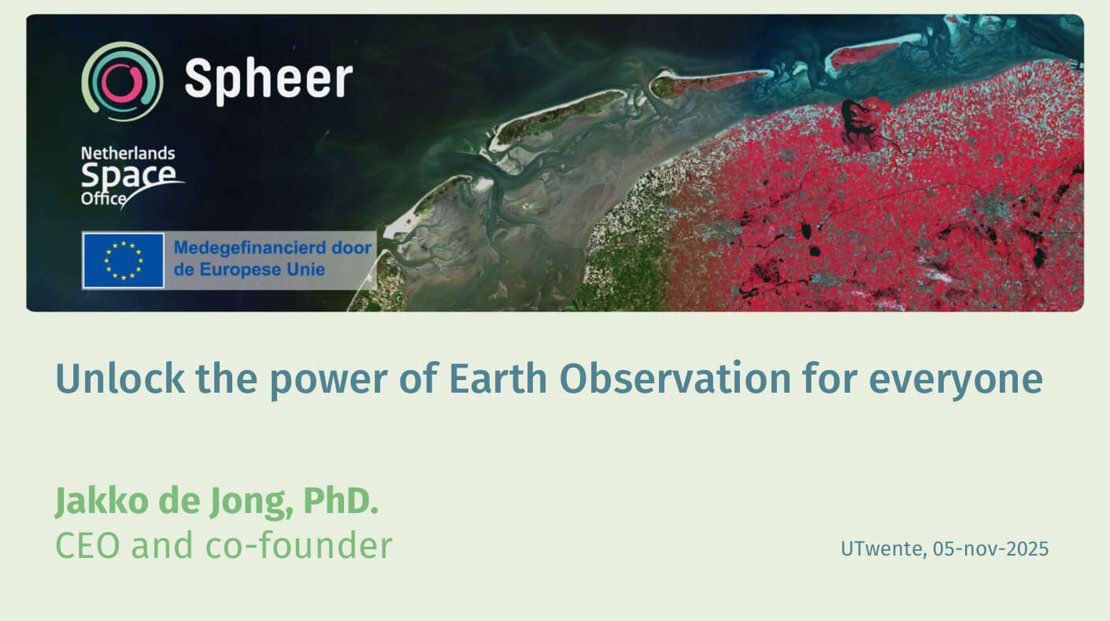
Spheer has developed Carto, a web-based Earth Observation engine powered by an in-house geospatial foundation model trained on time series of Sentinel-2 satellite data. With Carto, researchers, governments, land managers, and companies can develop custom monitoring solutions to analyze large areas and gain insights into biodiversity, agriculture, climate adaptation, infrastructure, and other spatial challenges.

In several use cases, such as detecting specific grasses on Dutch heathlands indicative of nitrogen deposition, Spheer's geo-FM has demonstrated improved temporal stability and a hundredfold reduction in required labeled data. Since September 2024, their small-data machine learning approach has been validated across dozens of use cases, both in the continental Netherlands and the Dutch Caribbean islands.

This talk Jakko de Jong, Director of Spheer, will explain how Carto works and share lessons learned while developing their geofoundation model. He will also showcase the existing use cases and discuss potential collaboration opportunities with researchers.
Date

5 November 2025, 11:00-12:00 CET

Venue

ITC Building, LA 2101
Hallenweg 8, 7522 NH, Enschede

or

Online

Speaker

Jakko de Jong
Director, Spheer

In my work as a data innovator, I combine my technological knowledge with my creativity and curiosity. When leading data science and artificial intelligence teams, I am most satisfied if the teams and clients feel they rise above themselves. Translating technology and science to the practical level of everyday business is always an important ingrediënt of the projects I work in.

I am passionate about using machine learning and data analytics for ideas that benefit the planet, backed by strong business cases. In my free time, I like to put my coding skills and creativity into making generative art.

Video

Presentation

Questions and Answers

  • We don't. During self-supervised learning, our Transformers learn how to recognize themselves what is useful data and what noisy data they should ignore when making the embeddings.

  • We can combine other features with our embeddings (eg. DEMs) by projecting them on our embeddings raster. This is not very challenging, it just has to be done. In the future, we like to provide users with the possibility to concatenate custom geodata with our embeddings, before training models on them.

  • There is no hard number I can think of. For our current FM, we use between 1 and 10% of The Netherlands, all available years of Sentinel-2 data. To be honest, we did not do ablation tests on this (yet).

  • Current one is trained only on Netherlands. We also trained a Caribbean model exactly the same way, that behaved well. This winter we are planning to train an EU wide model, and do spatial extrapolation tests.

  • Fair point. We only found out about this after the name Carto already stuck with our Dutch users. We are considering to just call the platform ‘Spheer’, after the company.

  • No.

  • It might be, although we have not tested this. Since the model uses per-pixel timeseries, and currently does not look at spatial correlations, I guess it will behave ok for input data with different spatial resolution. However, this data should have very similar spectral bands as Sentinel-2.